Passivation vs Pickling: What Stainless Steel Buyers Should Specify
Quick Summary
Specify ASTM A967 for the passivation step and ASTM A380 for pickling, and put both on the purchase order. Name the A480 surface finish (2B, No.4, 8K), the A967 acceptance test you will accept, and require a surface treatment declaration plus MTC with every shipment of welded pipe or sheet.
Specify ASTM A967 for the passivation step and ASTM A380 for pickling, and put both on the purchase order. Name the A480 surface finish (2B, No.4, 8K), the A967 acceptance test you will accept, and require a surface treatment declaration plus MTC with every shipment of welded pipe or sheet.
The two processes do different jobs
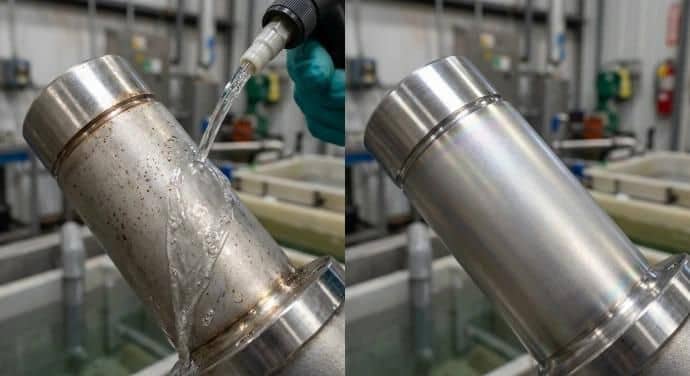
Pickling and passivation show up on the same certificate, and buyers treat them as synonyms. They are not. Pickling removes high-temperature oxide scale, weld heat tint, and free iron left behind by cutting tools or carbon steel contact. Passivation starts only on a surface that is already clean: it thickens the chromium-rich oxide film that gives stainless steel its corrosion resistance, and it strips nothing away. A part that was just pickled sits in an active state and still needs passivation, while a fabricated assembly that went through passivation right after welding keeps its heat-affected zone open to pitting. The causes of that damage and how to avoid them are set out in our note on the corrosion resistance of stainless steel.
What pickling removes, and when a buyer should demand it
ASTM A380 is the practice standard for cleaning, degreasing, and passivating stainless steel parts, equipment, and systems, and pickling practice sits inside it. Weld discoloration and heavy scale come off with a hydrofluoric acid and nitric acid gel laid over the seam and the heat-affected zone, held for the contact time the chemistry needs, then rinsed. The same step strips free iron that tooling, slings, or mild steel storage racks leave on the surface, so anything that has been welded, ground, or stored next to carbon steel should be pickled before a passivation bath is charged. Pickling does not add corrosion resistance; it returns the surface to a clean state that passivation can then work on. Yuze Metal runs pickling and passivation in line on 304 stainless steel welded pipe, and heat tint is checked before packing.
What passivation does, and which A967 method to name
ASTM A967 is the chemical passivation specification, and it covers a nitric acid method as well as a citric acid method. Citric acid is chosen more often these days because it removes free iron with less hazard to operators and less risk of an aggressive bath attacking the base metal. The specification also lets the buyer choose the acceptance test: water immersion, high humidity, salt spray, copper sulfate, and the free iron check with potassium ferricyanide each give a different signal. Put one of them in the order, or the mill runs the method it prefers and the argument starts when the goods arrive. Concentration and contact time matter as much as the choice of acid: a bath that runs too weak, or too long, leaves a surface that looks passivated and fails the first salt spray cycle.
Surface finish, process, and what to write on the purchase order
ASTM A480 covers plate and strip requirements, including the surface quality designations buyers order by. Match the finish to the duty the part sees, then attach the process requirement to it:
| Finish per A480 | Typical duty | Process to specify |
|---|---|---|
| No.1 | Tanks, process equipment, welded fabrications | Pickling, then passivation |
| 2B | General fabrication, liners, formed parts | Passivation after cleaning |
| No.4 | Architectural panels, appliance bodies, visible faces | Passivation, pickling only if welded |
| 8K | Mirror decoration, lift and elevator panels | Passivation after polishing, free iron test |
Our 304 stainless steel mirror sheet 8K ships with the polishing and passivation sequence recorded on the certificate, so the buyer can see which step followed which.
Two mistakes account for most field failures: welds that were passivated without being pickled first, which leaves the heat-affected zone exposed to pitting, and baths run at the wrong concentration or contact time. Both are avoidable at order stage. Put these five points in writing:
- Surface finish grade per ASTM A480 — 2B, No.4, 8K or No.1 — stated on the face of the order.
- Passivation specification: ASTM A967, the method chosen (nitric or citric), plus the concentration and time you require.
- Acceptance test: water immersion, high humidity, salt spray, copper sulfate, or free iron with potassium ferricyanide.
- Whether welded seams require pickling under ASTM A380, and which areas are covered.
- A surface treatment declaration plus the mill certificate (MTC) shipped with the goods.
Work with Yuze Metal
Yuze Metal Limited has exported stainless steel and aluminium products from Wuxi, China since 2012, shipping to more than 60 countries and supplying over 300,000 tons a year, with a mill certificate attached to every lot. For this specification we go one step further: on request we issue a surface treatment declaration that records the passivation method used against your ASTM A967 callout, the acceptance test performed, and the A480 finish shipped.
Write to us at sales@yuzemetal.com or message us on WhatsApp; we reply fast.
Quick answers for buyers
Does a pickled part still need passivation? Yes. Pickling cleans the surface, passivation builds the film. Fabricated and welded goods normally receive both, pickling first.
Which A967 test should I accept? Any test the specification names — water immersion, high humidity, salt spray, copper sulfate, or free iron with potassium ferricyanide — as long as you name it in the order.
Does 8K mirror sheet need passivation? Polishing embeds free iron in the surface, so yes: passivate after final polishing and ask for the free iron test result.