

Titanium Grade 1 vs Grade 5 (TA1 vs TC4): Purity, Strength and When to Pay for the Alloy
Quick Summary
Grade 1 titanium (UNS R50250) is commercially pure: soft, highly formable, and the most corrosion-resistant of the CP grades — min yield ~170 MPa per ASTM B265. Grade 5 (Ti-6Al-4V, UNS R56400) trades some corrosion tolerance for roughly five times the strength — min yield ~795 MPa annealed.
Grade 1 titanium (UNS R50250) is commercially pure: soft, highly formable, and the most corrosion-resistant of the CP grades — min yield ~170 MPa per ASTM B265. Grade 5 (Ti-6Al-4V, UNS R56400) trades some corrosion tolerance for roughly five times the strength — min yield ~795 MPa annealed. Buy Grade 1 for formability and chemical lining; buy Grade 5 when load, not corrosion, sets the design.
The one-paragraph answer
Grade 1 is the "chemical workhorse": nearly pure titanium, bends readily, welds cleanly, and resists oxidizing acids, seawater and chlorides better than any alloy grade — but it is soft. Grade 5 adds 6% aluminum and 4% vanadium to produce the most widely used titanium alloy in the world: aerospace brackets, high-pressure fittings, fasteners and medical hardware. The decision almost never involves corrosion — both grades handle chloride environments far better than stainless steel. It comes down to whether your part is formed or loaded.
Side-by-side comparison
| Property | Grade 1 (TA1, R50250) | Grade 5 (TC4, R56400) |
|---|---|---|
| Composition | ≥99% Ti (CP) | Ti–6Al–4V |
| Density | 4.51 g/cm³ | 4.43 g/cm³ |
| Min. yield (B265, annealed) | ~170 MPa | ~795 MPa |
| Min. UTS (B265, annealed) | ~240 MPa | ~860 MPa |
| Elongation (min.) | ~24% | ~10% |
| Heat treatable | No (annealed only) | Yes (solution + aging) |
| Relative weldability | Excellent | Good, needs discipline |
| Typical temper | Annealed | Annealed / STA |
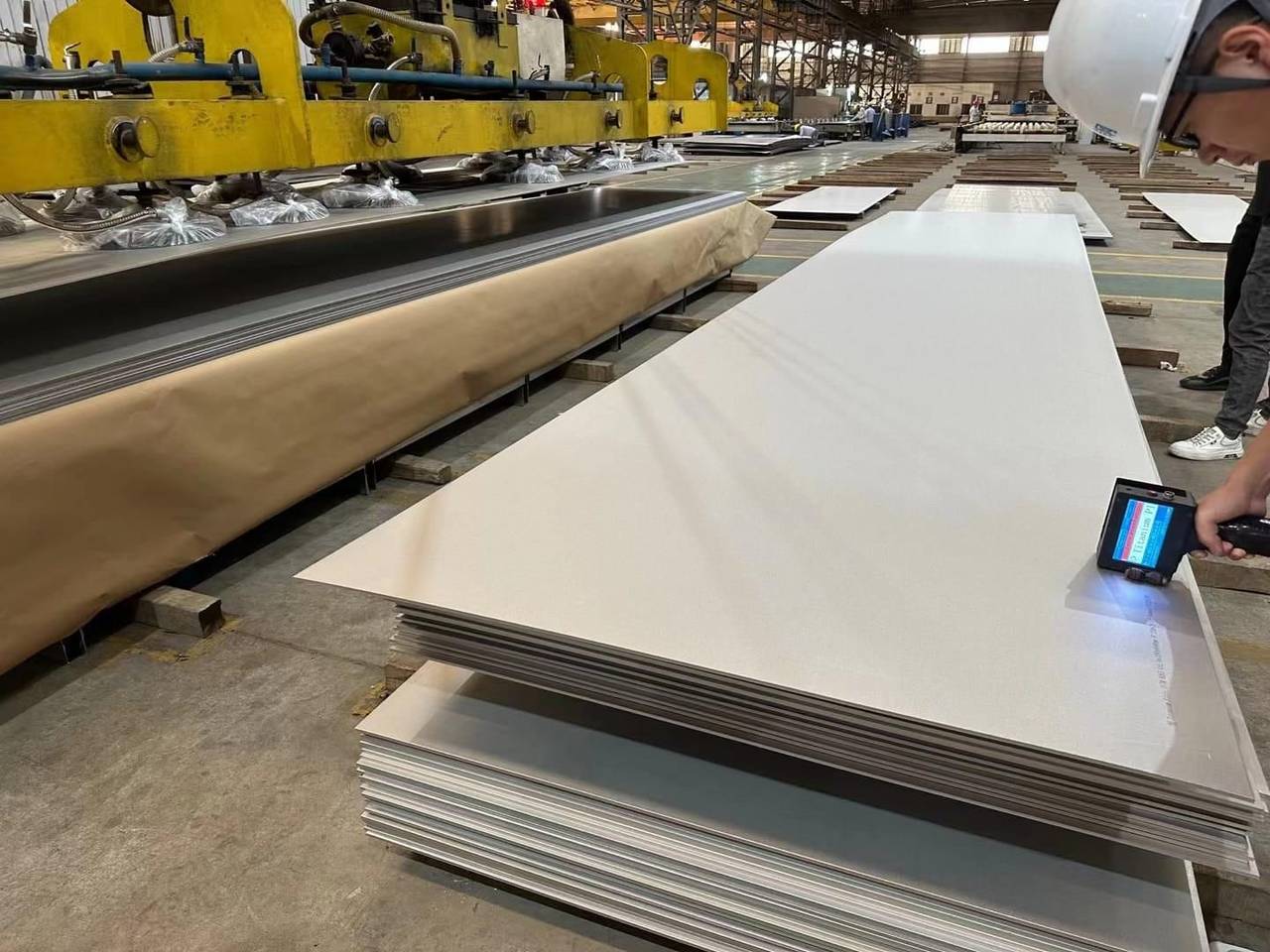
Values are minimums for plate under ASTM B265; confirm heat-specific data on the mill test certificate. Yuze Metal supplies Grade 1 as TA1 pure titanium plate and Grade 5 as TC4 titanium alloy plate, both in widths of 600–2000 mm.
Where Grade 1 earns its place
- Chemical and marine linings, cladding, expansion bellows. Deep drawability and superb chloride resistance; Grade 1 can be formed where alloy grades crack.
- Heat exchangers with seawater or brine. CP titanium is effectively immune to pitting in seawater at normal temperatures — no PREN juggling required.
- Anodizing racks, chlorate and bleach service. Where oxidizing chemicals destroy stainless grades over years, CP titanium lasts decades.
The trade-off is strength. At ~170 MPa minimum yield, Grade 1 sections must be roughly twice as thick as Grade 5 for the same load — which is why structural aerospace parts never use it.
Where Grade 5 is worth the premium
- Aerospace and airframe components. The default structural titanium worldwide; the annealed condition welds acceptably, and the solution-treated-and-aged condition pushes strength toward 1,000 MPa.
- High-pressure and high-cycle components — compressor blades, valve springs, hydraulic fittings — where specific strength (strength per weight) beats every common steel.
- Medical implants. Grade 5 (and its ELI variant) dominates orthopedics for biocompatibility plus fatigue strength; note that implant-grade material has stricter chemistry limits than standard B265 plate.
Grade 5 also holds strength at moderate temperature (usable to roughly 400 °C in many applications), whereas CP grades soften earlier.
Fabrication differences that surprise first-time buyers
- Welding. Both grades require inert-gas shielding on the face, root and back — titanium embrittles with oxygen pickup above ~400 °C. Grade 1 is forgiving; Grade 5 filler selection (usually matching or ELI filler) and interpass control matter more.
- Forming. Grade 1 bends and deep-draws like good austenitic stainless; Grade 5 forming needs heat for tight radii and should be hot-formed around 700–900 °C for complex shapes.
- Machining. Both grades machine slowly with rigid setups and flood coolant; Grade 5 work-hardens and chatters if the setup is light.
- Cutting. Plasma and laser cutting are acceptable with care; waterjet avoids heat-affected zones entirely and is preferred for critical parts.
Corrosion notes: where the grades differ
Both outperform stainless in chloride service, but the failure modes differ:
- Grade 1 wins in strongly oxidizing media and is the standard for wet chlorine, hypochlorite and seawater piping.
- Grade 5 is slightly less resistant to reducing acids and crevice corrosion than CP grades; for seawater immersion with crevices, designers often prefer CP grades or duplex stainless instead.
- Neither grade should contact dry chlorine or pure oxygen at pressure — titanium reacts violently; a standard safety note, not a marketing claim.
If the duty mixes chloride corrosion with structural load — offshore handrails, riser clamps — a common answer is a Grade 5 skeleton with CP or duplex wetted parts.
How to specify without overbuying
- State the medium, concentration and temperature — most titanium selections collapse to Grade 1 vs Grade 5 once these are known.
- Give the load path, not just the material: "bracket, 20 kN static" gets the right grade; "titanium plate, strong" gets expensive.
- Ask for the MTC to include interstitials (O, N, H, Fe) — oxygen content is the hidden variable that moves CP titanium strength around.
- Confirm temper explicitly: annealed for formability, STA only where the design uses the extra strength.
Work with Yuze Metal
Yuze Metal Limited, founded in 2012 in Wuxi, China, supplies titanium, stainless steel, nickel alloys and aluminum products to more than 60 countries, with annual volume above 300,000 tonnes and a mill test certificate on every batch. Our titanium plates ship in 600–2000 mm widths, annealed or STA as specified, with cutting and forming support for prototype through production volumes. Write to us at sales@yuzemetal.com or message us on WhatsApp; we reply fast.