2205 vs 2507 Duplex Stainless Steel: PREN, Chlorides and How to Choose
Quick Summary
2205 (S32205) duplex stainless has a PREN of about 34–36 and a minimum yield of 450 MPa — enough for most chemical, structural and mid-chloride service. 2507 (S32750) super duplex raises PREN to 40+ and yield to 550 MPa for seawater, RO and high-chloride duty.
2205 (S32205) duplex stainless has a PREN of about 34–36 and a minimum yield of 450 MPa — enough for most chemical, structural and mid-chloride service. 2507 (S32750) super duplex raises PREN to 40+ and yield to 550 MPa for seawater, RO and high-chloride duty. Choose by chloride temperature and content, not by "stronger is better".
The short answer for three common situations
- General chemical tanks, structural members, moderate chloride exposure (below roughly 30 °C): 2205 is the right call. It delivers double the yield of 316L at roughly half the nickel content.
- Seawater directly, brines above ~40 °C, desalination and offshore splash zones: step up to 2507. Its higher chromium, molybdenum and nitrogen hold pitting resistance where 2205 starts to lose margin.
- Budget-critical projects considering 2205 for mild service: a well-chosen 316L may be cheaper than 2205 for thin sections; 2205 earns its premium through strength and chlorine tolerance, not through being universally "better".
Side-by-side comparison
| Property | 2205 (S32205) | 2507 (S32750) |
|---|---|---|
| EN designation | 1.4462 | 1.4410 |
| Chromium | ~22% | ~25% |
| Nickel | ~5% | ~7% |
| Molybdenum | ~3% | ~3.5–4% |
| Nitrogen | 0.14–0.20% | 0.24–0.32% |
| PREN (typical) | 34–36 | 40–43 |
| Min. yield (ASTM A240) | 450 MPa | 550 MPa |
| Typical CPT | ~35–40 °C | ~60 °C and above |
| Common nickname | Duplex / Lean duplex | Super duplex |
Values are typical published ranges for mill product under ASTM A240/A790; always confirm the heat-specific mill test certificate for ordered material.
What PREN actually tells you
PREN — the pitting resistance equivalent number — is a weighted score of chromium, molybdenum and nitrogen: PREN = %Cr + 3.3×%Mo + 16×%N. It ranks a grade's resistance to chloride pitting, but it is a ranking tool, not a guarantee.
- A PREN in the mid-30s (2205) handles chloride exposure that defeats 304 outright and outperforms 316L in most brackish conditions.
- PREN 40+ (2507) is the accepted threshold for seawater service, which is why desalination plants and offshore designers default to super duplex for wetted parts.
We explain how PREN appears on real certificates in our guide to pitting resistance and PREN on mill test certificates.
Chloride temperature is the real decision variable
Pitting resistance drops as temperature rises. Published critical pitting temperature ranges put 2205 around 35–40 °C and 2507 above 60 °C — a gap that matters for hot brines, geothermal brine lines and tropical seawater.
A useful rule of thumb when reviewing a duty specification:
- Ambient fresh water or low-chloride process water: 304 is usually sufficient; 2205 is a durability upgrade, not a requirement.
- Brackish water, coastal condensers, chloride chemicals below ~35 °C: 2205.
- Seawater cooling, desalination, high-pressure brine, splash-zone structural parts: 2507.
- Between the bands (35–60 °C chlorides): get a corrosion engineer to review the specific chemistry — this is the zone where "matching" a grade by table alone goes wrong.
Strength: where 2205 quietly pays for itself
Duplex grades carry roughly double the yield strength of standard austenitic plate. 2205's 450 MPa minimum yield against 316L's ~205 MPa lets designers reduce wall thickness in pressure-bearing and structural applications — which offsets part of the per-kilogram price premium. 2507 pushes the floor to 550 MPa for the most demanding sections.
| Grade | Min. yield (A240) | Typical structural consequence |
|---|---|---|
| 316L | ~205 MPa | Baseline wall thickness |
| 2205 | 450 MPa | Possible thickness reduction, fewer stiffeners |
| 2507 | 550 MPa | Highest load per kilogram, offshore duty |
The saving shows up in fabrication and weight, so compare on installed cost, never on price per tonne alone.
Where each grade actually shows up
Field usage is the fastest sanity check on a selection:
- 2205: chemical storage tanks, pulp and paper digesters, bridge and architectural structural sections, oil and gas gathering lines, flue gas desulphurization ducting, offshore handrails and secondary structure.
- 2507: desalination high-pressure brine piping, seawater coolers and condensers, umbilicals and subsea hardware, propeller shafts, chemical tankers' cargo tanks, hydrochloric and acetic acid service at moderate concentrations.
Notice the overlap zone: both grades appear around offshore and chemical plants. The differentiator is almost always chloride concentration and temperature at the wetted surface, plus whether crevices exist (flanges, deposits, gasket faces) — crevice conditions demand more PREN than the bulk chemistry suggests.
Fabrication notes that decide project success
Both grades are weldable with matched fillers (2209 for 2205, 2594 for 2507) and standard austenitic practice, with two disciplines:
- Heat input and interpass control. Duplex microstructure degrades if welding runs too hot or too slow; follow the WPS ranges rather than austenitic habits.
- Solution annealing after heavy forming. Severe cold work shifts the ferrite/austenite balance; heavy-formed parts should be solution annealed and rapidly quenched.
Machining and forming are noticeably harder than 304 — plan tooling and press capacity accordingly.
What Yuze Metal supplies
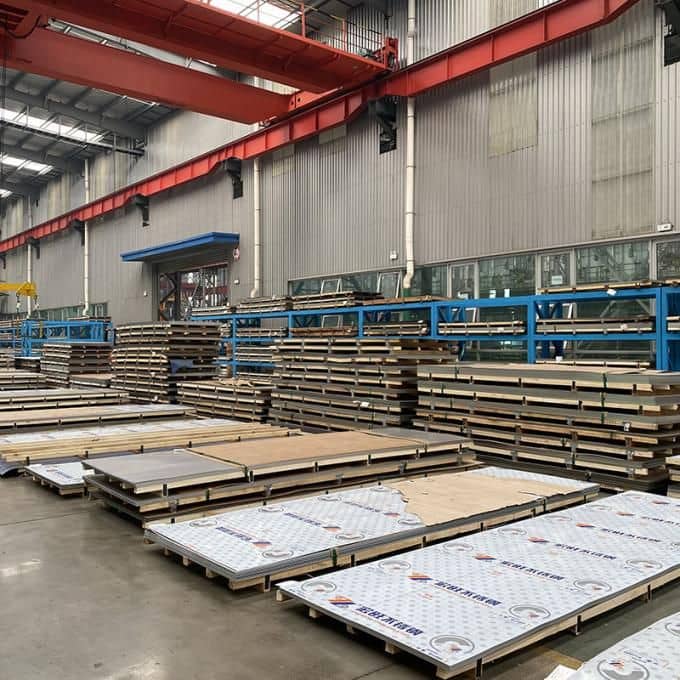
Yuze Metal stocks and processes both grades as plate and coil in production widths of 1500–2500 mm, finished No.1 or 2B, with custom cutting lengths. See the product pages for 2205 duplex stainless steel plate and 2507 duplex stainless steel plate, or our broader guide to duplex stainless steel selection.
Yuze Metal Limited, founded in 2012 in Wuxi, China, supplies stainless steel and specialty alloys to more than 60 countries, with annual supply above 300,000 tonnes and a mill test certificate on every heat. Write to us at sales@yuzemetal.com or message us on WhatsApp; we reply fast.