Why 304 Stainless Steel Becomes Magnetic After Cold Work
Quick Summary
Fully annealed 304 (about 18Cr-8Ni) is austenitic and essentially non-magnetic, with relative permeability near 1.003–1.02. Cold work such as bending, deep drawing, embossing or roll forming creates strain-induced martensite (α′); after heavy deformation the steel attracts a magnet, with local perme…
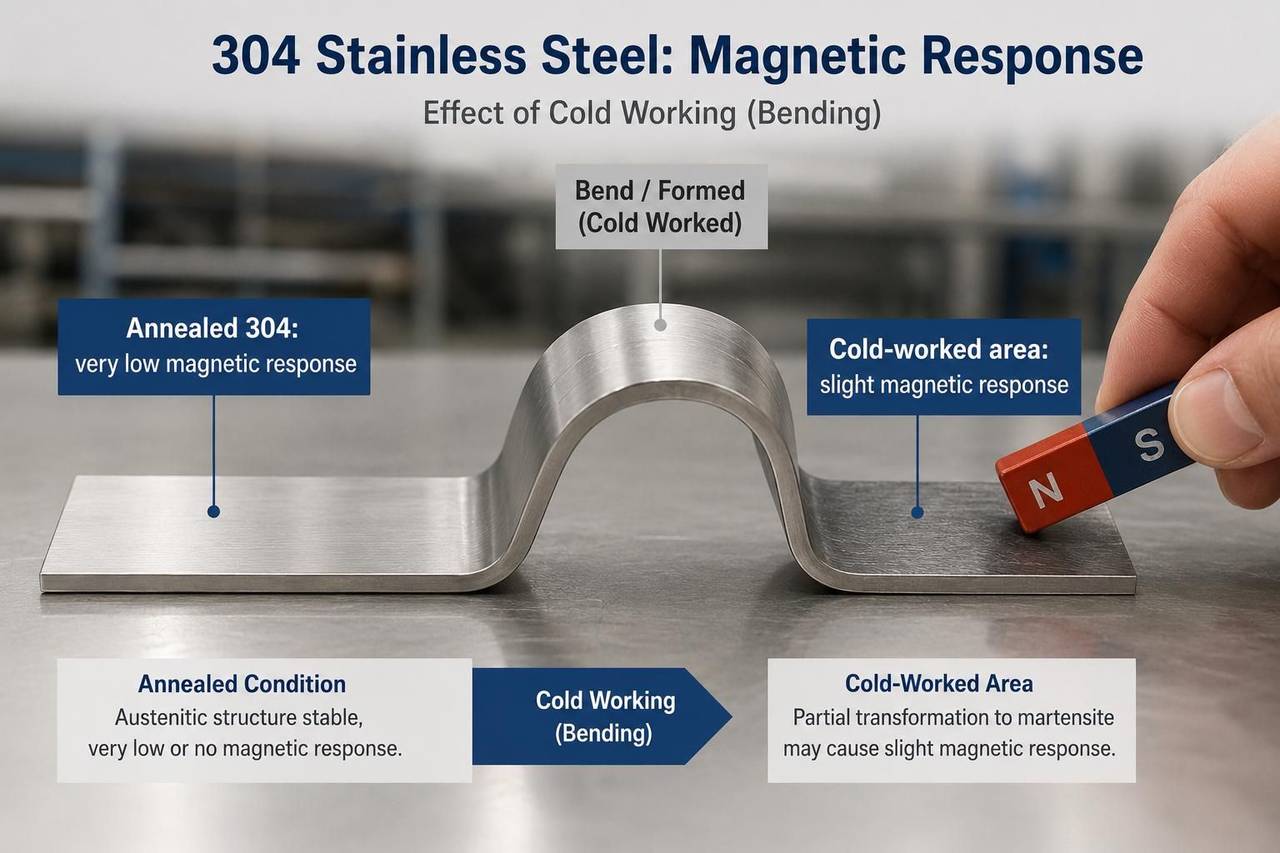
Fully annealed 304 (about 18Cr-8Ni) is austenitic and essentially non-magnetic, with relative permeability near 1.003–1.02. Cold work such as bending, deep drawing, embossing or roll forming creates strain-induced martensite (α′); after heavy deformation the steel attracts a magnet, with local permeability rising above 1.05–1.10.
Why annealed 304 is essentially non-magnetic
Type 304 contains roughly 18% chromium and 8% nickel. After solution annealing and rapid cooling its structure is almost entirely austenite, a non-magnetic phase, and its relative permeability sits close to 1.003–1.02 — a magnet finds nothing to hold on a fully annealed sheet.
This is the condition a mill test certificate normally describes: hot rolled and pickled, or cold rolled and annealed. Instrument, medical and sensor equipment makers ask for 304 because the delivered material behaves like a non-magnetic metal in service.
"Non-magnetic" describes the annealed delivery condition, not every piece of 304 later in fabrication. Magnetism here is a condition property, not a chemistry property: the certificate stays identical while the part starts attracting a magnet, because the phase balance shifted.
Cold work converts austenite into strain-induced martensite
When 304 is bent, drawn, embossed or roll formed, the austenite lattice deforms plastically, and part of that deformation is absorbed by a diffusionless transformation: austenite turns into strain-induced martensite (α′), which is ferromagnetic. Two variables decide how much forms — how much deformation accumulates, and how cold it is when it happens. Colder forming and heavier reduction both mean more martensite, so a tight radius formed in winter reads more magnetic than the same radius formed warm.
Once cold work is heavy enough, the steel moves from "no pull" to "the magnet sticks": local permeability can climb above 1.05–1.10, enough for a magnet to hold on a deep-drawn shell, a roll-formed profile or a heavily embossed panel.
The operations that most reliably make 304 magnetic:
- tight-radius bending and hemming;
- deep drawing and stretching;
- embossing, pattern rolling, roll forming and sizing;
- repeat forming passes with no intermediate anneal.
The chemistry never changes: the certificate still reads 304. Only the phase balance shifts, and solution annealing with pickling reverses it. Roll embossing is severe cold work, so mild pull on an embossed panel is expected — see our 304 embossed stainless steel sheet.
Magnetic response by grade and condition
Pull strength depends on grade and on how much cold work the part absorbed. Typical behaviour:
| Grade and condition | Relative permeability | Reaction to a magnet | What it means on site |
|---|---|---|---|
| 304, fully annealed or solution annealed | about 1.003–1.02 | none, or a trace | meets a non-magnetic requirement |
| 304, bent, drawn or roll formed | above the annealed level | weak pull, usually at corners | normal after forming |
| 304, heavily cold worked: embossed, deep drawn, tight bends | about 1.05–1.10 and above | magnet attaches locally | expected on embossed and deep-drawn parts |
| 316, same amount of deformation | clearly lower than 304 at equal strain | noticeably weaker | preferred when magnetism matters |
| Weld bead with matched filler | about 3–10 FN ferrite | weak pull along the bead | normal, not a defect |
| 201 and other low-nickel grades, cold worked | — | magnetic more often than 304 | do not substitute for non-magnetic duty |
Three rows usually decide the order:
- 316 holds its austenite better. It carries about 2% molybdenum and more nickel than 304, so at equal deformation it transforms less and stays significantly less magnetic. See our 304 vs 316 stainless steel: complete comparison for B2B buyers, and for sections we ship 316 stainless steel hollow section square tube.
- Welds stay weakly magnetic even when the parent metal is not. Weld metal normally holds about 3–10 FN of ferrite to guard against hot cracking, so a magnet drags along the bead. That is normal metallurgy, not a material defect.
- Low-nickel grades show magnetism first. 201 and similar grades have less stable austenite, so they turn magnetic sooner, in service and after light forming. If the drawing says non-magnetic, keep the grade written on the certificate.
How to avoid magnetic disputes before you order
A magnet sorts material but makes a poor acceptance test: it cannot separate 304 from 316 or confirm alloy identity, so grade checks run through PMI (XRF alloy analysis). Austenitic stainless also does not suit magnetic particle inspection (MT); use dye penetrant testing (PT) for surface-breaking cracks.
Agree the following before the purchase order goes out:
- Write the magnetic limit into the contract. State a maximum relative permeability — ≤1.02 for instrument, medical or sensor work, ≤1.05 where a mild pull is tolerable — and name the condition it is measured in.
- Specify the supply condition. Ask for annealed, or solution-annealed and pickled, material whenever non-magnetic performance is required, instead of leaving delivery condition to the mill default.
- Separate grade checks from magnetic checks. Require PMI (XRF) for grade confirmation and PT for surface defects; a magnet result is neither.
- Confirm acceptance after forming with the end user. Slight magnetic response after bending or drawing is normal, so agree in advance whether a re-anneal is required or parts are accepted as formed.
- Put the expectation in the shipping documents. Ask that the cold-work limitation travel with the shipment, so your inspector, your fabricator and your customer read the same criteria.
Work with Yuze Metal
Yuze Metal Limited has exported from Wuxi, China since 2012, shipping stainless steel and aluminium products to more than 60 countries, with annual supply above 300,000 tonnes and an MTC attached to every batch. For magnetic-sensitive work we deliver annealed or solution-annealed material and state the cold-work limitation on the certificate, so your inspection team and your customer work from the same figure.
Quick answers before you order
- Will a formed 304 part stay magnetic? Usually yes, at least weakly. The pull comes from deformation, not a change of grade; solution annealing removes most of it.
- Does magnetism mean the wrong alloy was shipped? No. Confirm identity with PMI (XRF): magnet behaviour cannot tell 304 from 316, and the Yuze Metal team runs PMI on request before shipment.
- Can we order 304 against a magnetic limit? Yes — state ≤1.02 or ≤1.05 with the supply condition, and the quotation is written to that limit.
Write to us at sales@yuzemetal.com or message us on WhatsApp; we reply fast.